


Not Every Greater Boston City and Town Saw Rising Home Prices in 2025
In a region where home prices still look strong, it’s important for home buyers to get the local story.
Across Greater Boston, the median price of a single-family home rose 5.1 percent in 2025 compared with 2024, while condominium prices slipped 0.2 percent, according to data compiled by The Warren Group. Those topline numbers capture a market that remains expensive and competitive. But they can also hide what home buyers and sellers most need to know: plenty of communities did not follow the Greater Boston script.
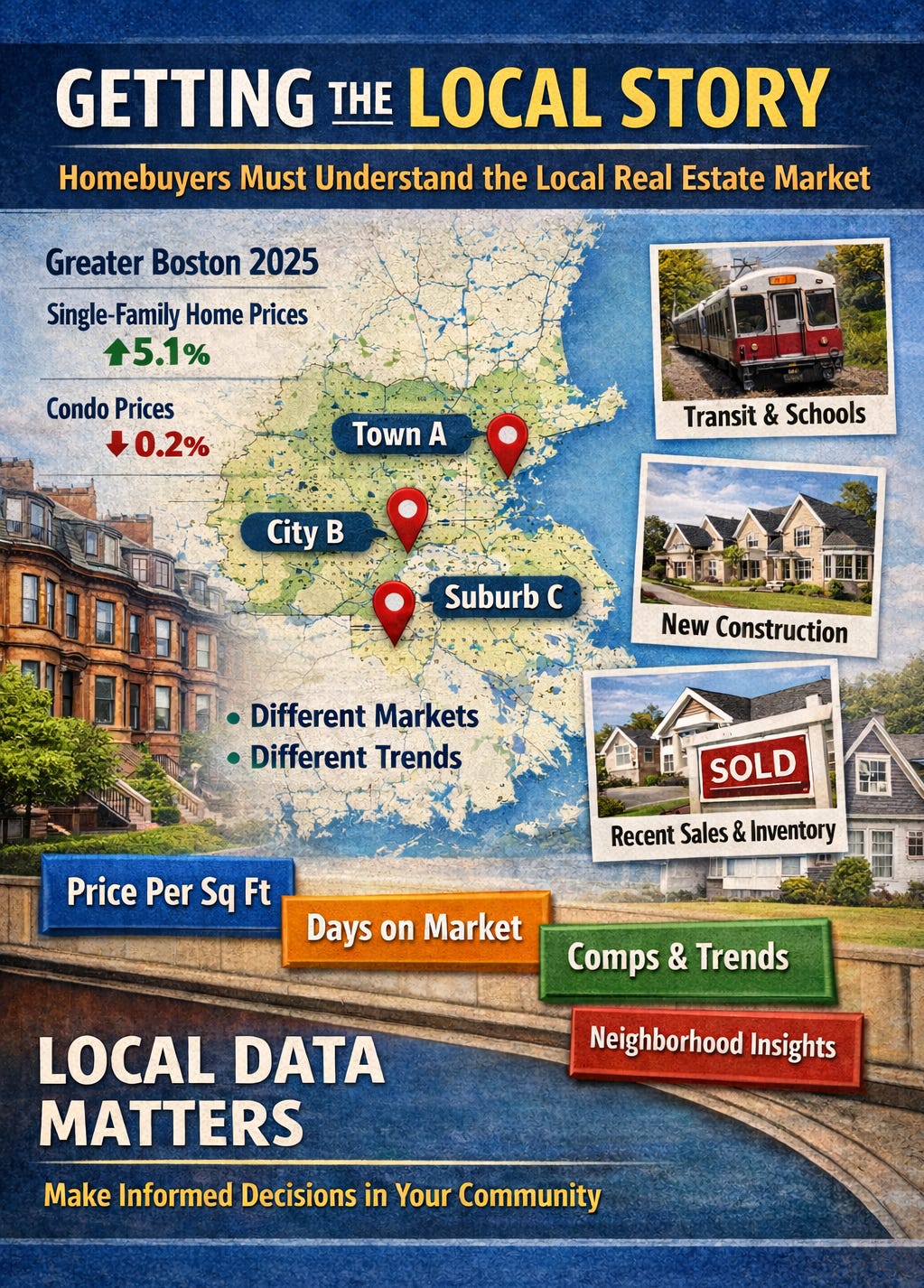
That is why real estate remains local. “Greater Boston” is not one market so much as dozens of overlapping ones, shaped by school districts, commuter rail or subway stops, new construction, zoning, inventory, and how many homes in a given town happen to sell in a particular year. A small shift in the sales mix — more starter homes trading hands in one place, more high-end properties in another — can affect a median price without saying much about what a typical home buyer will face in a particular city or town.
For home buyers, metro-wide or statewide statistics can provide useful context, but their value is limited. Local data, including price per square foot, recent comparable sales, changes in inventory, and days-on-market trends, helps prospective home buyers avoid overreacting to headlines that may not apply to the homes they are actually interested in.
The closer the data gets to the property type, neighborhood, and price tier a home buyer is shopping in, the more it helps them make an informed decision.
Where Did Single-family Home Prices Decline in a Rising Greater Boston Market in 2025?
In total, 25 cities and towns, including a few Boston neighborhoods, in Greater Boston experienced a median single-family home price decline of 0.50 percent or more in 2025 compared to 2024.
Regarding condominiums, 59 cities and towns in Greater Boston saw median condo prices decline by 0.50 percent or more in 2025 compared to 2024.
The data comes from The Warren Group, which defines Greater Boston as the 139 Massachusetts cities and towns located within Interstate 495.
The following are 20 Greater Boston cities and towns in which the median price of a single-family home decreased by 0.50 percent or more.
The cities and towns in bold saw declines of 5 percent or more in 2025 from 2024.
1. Acton: 2024, $952,500; 2025, $943,750; change: -0.9 percent
2. Avon: 2024, $587,000; 2025, $558,500; change: -4.9 percent
3. Franklin: 2024, $722,500; 2025, $700,000; change: -3.1 percent
4. Halifax: 2024, $525,000; 2025, $512,500; change: -2.4 percent
5. Hamilton: 2024, $860,000; 2025, $830,000; change: -3.5 percent
6. Hopkinton: 2024, $1,038,000; 2025, $1,010,000; change: -2.7 percent
7. Lincoln: 2024, $1,725,000; 2025, $1,497,500; change: -13.2 percent
8. Malden: 2024, $710,000; 2025, $697,500; change: -1.8 percent
9. Marblehead: 2024, $1,055,210; 2025, $1,004,500; change: -4.8 percent
10. Medfield: 2024, $1,175,000; 2025, $1,076,250; change: -8.4 percent
11. Middleton: 2024, $967,000; 2025, $944,500; change: -2.3 percent
12. Nahant: 2024, $930,000; 2025, $845,000; change: -9.1 percent
13. Plympton: 2024, $650,000; 2025, $620,000; change: -4.6 percent
14. Salisbury: 2024, $665,000; 2025, $635,000; change: -4.5 percent
15. Southborough: 2024, $1,049,500; 2025, $972,500; change: -7.3 percent
16. Stow: 2024, $820,000; 2025, $780,000; change: -4.9 percent
17. Sudbury: 2024, $1,235,000; 2025, $1,152,000; change: -6.7 percent
18. Wayland: 2024, $1,187,500; 2025, $1,175,000; change: -1.1 percent
19. West Bridgewater: 2024, $575,000; 2025, $550,000; change: -4.3 percent
20. Winthrop: 2024, $727,000; 2025, $719,000; change: -1.1 percent
The following are 31 Greater Boston cities and towns in which the median condominium price decreased by 0.5 percent or more.
The cities and towns in bold saw declines of 5 percent or more in 2025 from 2024.
1. Beverly: 2024, $481,000; 2025, $444,000; change: -7.7 percent
2. Brockton: 2024, $280,000; 2025, $275,300; change: -1.7 percent
3. Burlington: 2024, $832,500; 2025, $785,000; change: -5.7 percent
4. Canton: 2024, $599,500; 2025, $543,000; change: -9.4 percent
5. Chelmsford: 2024, $445,000; 2025, $440,000; change: -1.1 percent
6. Chelsea: 2024, $452,500; 2025, $437,000; change: -3.4 percent
7. Everett: 2024, $459,900; 2025, $440,000; change: -4.3 percent
8. Framingham: 2024, $355,000; 2025, $330,000; change: -7.0 percent
9. Gloucester: 2024, $597,000; 2025, $525,000; change: -12.1 percent
10. Hanson: 2024, $603,500; 2025, $519,950; change: -13.8 percent
11. Haverhill: 2024, $410,000; 2025, $400,000; change: -2.4 percent
12. Lynn: 2024, $363,234; 2025, $339,000; change: -6.7 percent
13. Malden: 2024, $466,000; 2025, $424,000; change: -9.0 percent
14. Marblehead: 2024, $595,000; 2025, $580,000; change: -2.5 percent
15. Marlborough: 2024, $422,000; 2025, $404,750; change: -4.1 percent
16. Medford: 2024, $680,000; 2025, $655,000; change: -3.7 percent
17. Medway: 2024, $581,500; 2025, $520,500; change: -10.5 percent
18. Melrose: 2024, $592,500; 2025, $555,000; change: -6.3 percent
19. Natick: 2024, $702,500; 2025, $685,000; change: -2.5 percent
20. Norwood: 2024, $515,000; 2025, $422,500; change: -18.0 percent
21. Pembroke: 2024, $550,000; 2025, $500,000; change: -9.1 percent
22. Randolph: 2024, $425,000; 2025, $350,500; change: -17.5 percent
23. Revere: 2024, $482,000; 2025, $436,000; change: -9.5 percent
24. Sharon: 2024, $345,000; 2025, $335,000; change: -2.9 percent
25. Somerville: 2024, $900,000; 2025, $875,000; change: -2.8 percent
26. Stoneham: 2024, $444,500; 2025, $426,000; change: -4.2 percent
27. Swampscott: 2024, $460,000; 2025, $447,500; change: -2.7 percent
28. Waltham: 2024, $711,500; 2025, $630,000; change: -11.5 percent
29. Whitman: 2024, $458,700; 2025, $435,000; change: -5.2 percent
30. Wilmington: 2024, $661,500; 2025, $632,500; change: -4.4 percent
31. Woburn: 2024, $691,878; 2025, $688,000; change: -0.6 percent
Will Lower Mortgage Interest Rates Ignite the Spring Homebuying Season?
Average U.S. mortgage rates fell into the 5 percent range for the first time in three and a half years, a potential boost for the spring homebuying season. Freddie Mac reported that the 30-year fixed-rate mortgage averaged 5.98 percent as of February 26, 2026, down from 6.01 percent a week earlier and from 6.76 percent a year ago.
The 15-year fixed-rate mortgage, a popular choice for homeowners who want to refinance, averaged 5.44 percent, up from 5.35 percent the prior week, and down from 5.94 percent a year earlier.
Early demand showed mixed signals. The Mortgage Bankers Association said its seasonally adjusted Purchase Index fell 5 percent for the week ending February 20. The unadjusted index dipped 1 percent from the prior week, but it was 12 percent higher than the same week one year earlier.
A client under agreement on a home in Massachusetts locked in a 5.75 percent fixed interest rate on Friday afternoon.
Pro Tip: Mortgage interest rates can change daily, and rates sometimes change intraday. If your mortgage interest rate isn’t locked, there is no guarantee what the interest rate on your loan will be at the time of closing. You have to be sure your lender has locked the rate. You should never assume your loan officer has locked your rate without confirmation.
Will the Billion-Dollar Cut to Mass Save Hurt Homeowners’ Plans to Make Their Homes More Energy Efficient?
The Massachusetts House of Representatives passed an energy bill last week that included a $1 billion cut to the energy efficiency program Mass Save, which is funded by ratepayers through a charge on utility bills.
Legislators hope their bill will cut rising utility costs.
CommonWealth Beacon reported that the cut to Mass Save is “primarily aimed at its administrative, marketing, and advertising” budgets. The bill orders the inspector general to produce a report on the program by next year.
Mass Save helps homeowners make energy-efficient upgrades by offering a wide range of services, rebates, incentives, training, and information.
Many first-time home buyers utilize Mass Save programs to make necessary energy-efficiency upgrades to older homes.